
📜 Shiva Sati Katha – The Story of Love & Sacrifice
✨ The divine story of pure devotion, cosmic love, and ultimate sacrifice.
.
✨From the Shiva Purana to the origin of Shakti Peethas.
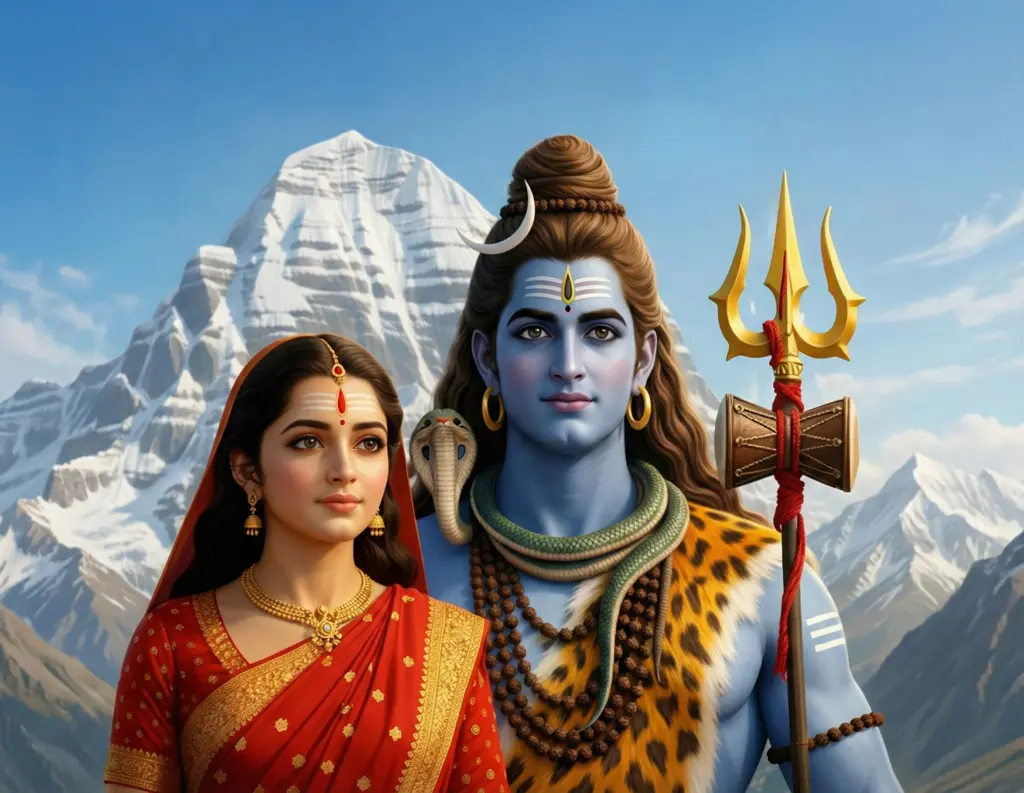
🌸 Shiva and Sati — the union of consciousness and devotion
📜 Origin of the Shiva Sati Story
The story of Sati is primarily described in the Shiva Purana, with references in other Puranic texts.
Sati was born as the daughter of Daksha Prajapati, a powerful yet ego-driven ruler.
Despite Daksha’s opposition, Sati chose Shiva as her eternal consort, representing truth choosing consciousness over social approval.
🕉️ Shiv Aur Sati Ki Kahani – Complete Story
In Hindu philosophy, Shakti represents the divine feminine energy that sustains the universe. She manifests in many forms—Durga, Kali, Lakshmi, Saraswati—each symbolizing strength, destruction, prosperity, or wisdom.
Among these powerful manifestations, one form stands out for her profound story of devotion and sacrifice: Goddess Sati.
Her story is not only a tale of divine love but also a deep lesson about ego, emotion, and the balance of the cosmos.
Sati: Daughter of King Daksha
According to ancient scriptures, Sati—also known as Dakshayani—was the daughter of King Daksha Prajapati and his wife, often named Prasuti or Virini in various texts.
Daksha had twenty-four daughters, each representing a specific divine quality. Among them, Sati was regarded as the embodiment of truth and purity.
But to truly understand Sati’s journey, one must first understand her father.
Who Was Daksha Prajapati?
Daksha was one of the Manas Putras—the mind-born sons of Lord Brahma.
In the Hindu Trinity (Trimurti):
Brahma is the Creator
Vishnu is the Preserver
Shiva is the Destroyer and Transformer
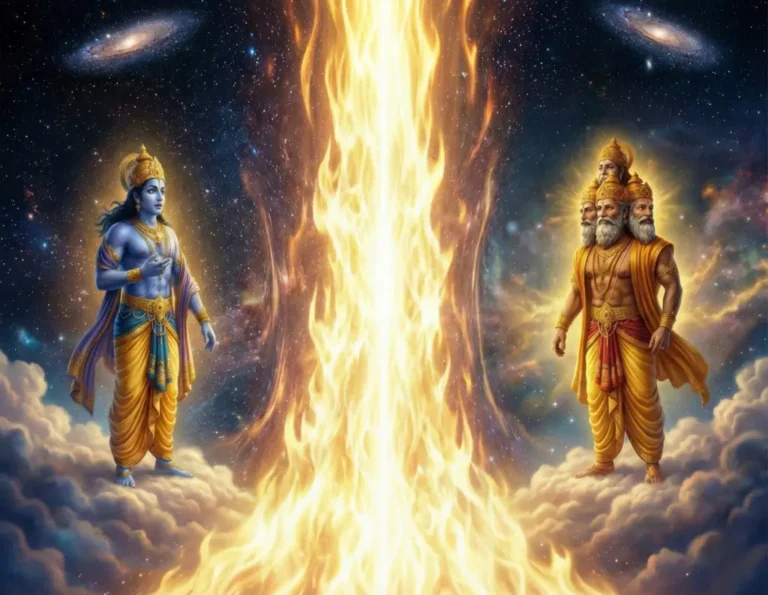
According to the Shiva Purana, in the beginning, there was only an infinite cosmic existence. From this emerged Lord Vishnu. While Vishnu rested in deep yogic sleep, a sacred lotus grew from his navel. From that lotus appeared Lord Brahma.
Brahma created the four Vedas and, through the power of his mind and will, brought forth several beings known as the Manas Putras. Daksha was one of them.
The Deeper Meaning of “Manas Putra”
The concept of a mind-born son carries a profound philosophical meaning. It suggests that creation begins not with physical matter but with consciousness and intention.
In essence, thought is the first seed of creation.
This ancient idea still resonates today. Every invention, every innovation, begins as an idea before it becomes reality. The story reminds us that the power of thought is divine and transformative.
The Marriage of Sati and Shiva
Sati was deeply devoted to Lord Shiva from a young age. Despite her father Daksha’s strong disapproval, she performed intense penance to win Shiva as her husband.
Eventually, Shiva accepted her devotion, and they were married.
This was not merely a union between two individuals—it was the merging of two cosmic forces:
Sati, the embodiment of devotion and truth
Shiva, the master of transformation and cosmic dissolution
Together, they symbolized universal balance.
However, Daksha never approved of Shiva. He viewed him as a strange ascetic who lived in cremation grounds, covered in ash, surrounded by spirits and mystical beings. To Daksha, Shiva did not fit the image of a respectable son-in-law.
Daksha’s Yajna and the Great Insult
During a grand sacrificial ritual (Yajna) organized for the welfare of creation, many gods and sages were invited.
When Daksha entered the assembly, all rose in respect—except Brahma and Shiva.
Daksha felt deeply insulted that Shiva, his son-in-law, did not stand to honor him. Blinded by ego, he publicly criticized and insulted Shiva before the gathered assembly.
Shiva remained calm and silent.
But Daksha’s resentment only grew stronger.
Later, he organized another grand ritual known as the Brihaspati-Sava Yajna. Invitations were sent to all divine beings—except Shiva and Sati.
Sati’s Pain and Sacrifice
When Sati learned of the yajna at her father’s home, she wished to attend. Shiva gently advised her not to go uninvited, but Sati insisted and went alone.
At the ceremony, she saw all the gods and kings honored. However, there was no seat, no offering, and no recognition for Shiva.
Worse still, her father ignored her presence.
Heartbroken and humiliated, Sati addressed the assembly. She expressed her disappointment and condemned the insult directed toward her husband.
Seeing that none of the gods defended Shiva, Sati felt even more wounded.
She declared:
“This body was given to me by my father. If this very body has become the cause of my beloved’s insult, I no longer wish to keep it.”
Sati then entered the sacrificial fire. When the fire god Agni hesitated, unable to burn her, she invoked her inner yogic energy and immolated herself through her own spiritual power.
Shiva’s Wrath and the Destruction of the Yajna
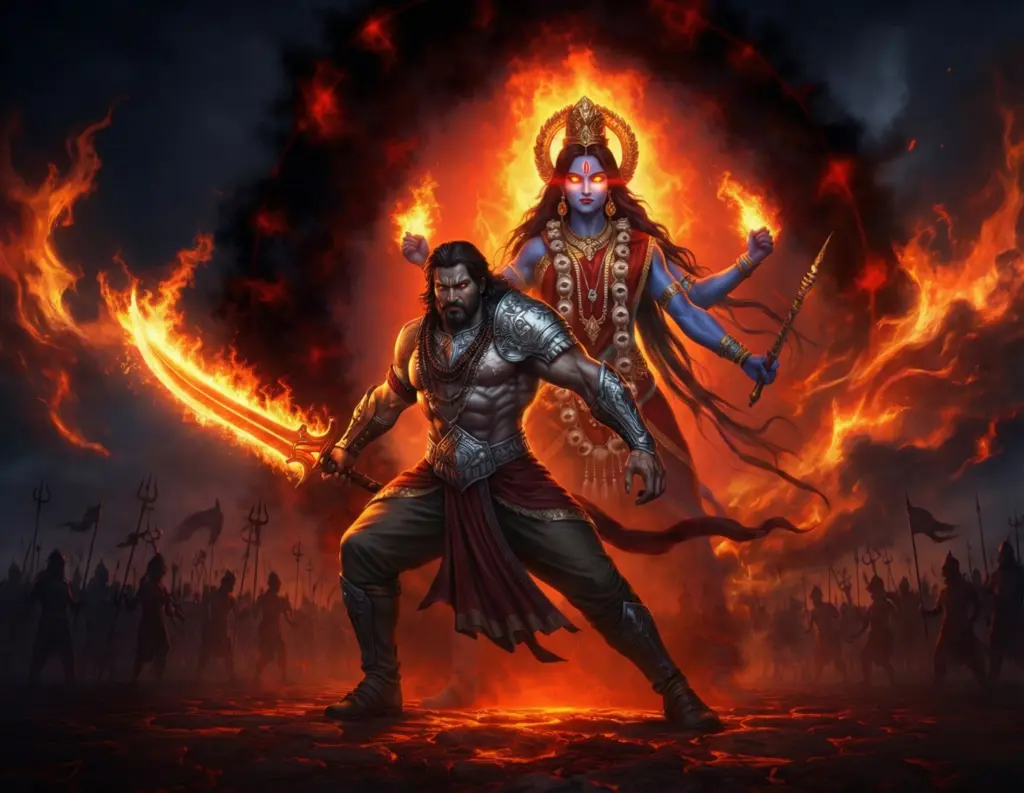
When news of Sati’s death reached Mount Kailash, Shiva’s grief transformed into cosmic fury.
From his matted locks emerged two fierce manifestations—Veerabhadra and Bhadrakali.
He commanded them to destroy Daksha’s yajna and punish his arrogance.
They stormed the ritual site. Gods and sages fled in fear. Veerabhadra beheaded Daksha, and the sacrificial ceremony was destroyed.
However, when the gods pleaded for mercy, Shiva’s compassion resurfaced. He restored Daksha to life by placing a goat’s head upon his body.
Daksha, humbled and freed from ego, bowed to Shiva and sought forgiveness.
The Creation of the Shakti Peethas
Shiva’s sorrow did not subside. He carried Sati’s lifeless body and began the Tandava—the cosmic dance of destruction. The universe trembled with each step.
To restore balance, the gods sought Lord Vishnu’s help.
Using his Sudarshan Chakra, Vishnu divided Sati’s body into 51 parts. Wherever her body parts, ornaments, or garments fell, sacred sites were established. These holy places are known as the 51 Shakti Peethas.
They are spread across present-day India, Nepal, Bangladesh, Pakistan, and Sri Lanka, and continue to be revered as powerful centers of divine feminine energy.
The Spiritual Message of the Story
The story of Shiva and Sati is not merely a tale of tragedy.
It teaches profound lessons:
Ego can blind even the wise.
Emotional attachment, when uncontrolled, can lead to destruction.
Silence in the face of injustice can deepen suffering.
Love and devotion possess transformative power.
Sati’s sacrifice symbolizes ultimate devotion.
Shiva’s rage reflects the depth of divine grief.
Vishnu’s intervention represents balance and compassion.
Ultimately, the story reminds us that when ego disrupts harmony, destruction follows—but from destruction, new creation always arises.
🎧 Listen to the Sacred Story of Shiva and Sati
🪔 Teachings from the Shiv Sati Katha
🌼 Why the Shiva Sati Story Matters Today
The vrat is simple, sattvic, and focused on devotion rather than hardship. Follow the below written step-by-step process :
📚 Explore Related Sacred Stories
Shiva-Sati tale is deeply connected with other divine stories, and spiritual disciplines. If you are drawn to devotional wisdom, you may also like other stories and devotional songs which will help to build up a spiritual continuity and deeper understanding of Vedic living.
-
Mahashivratri Jyotirlinga Katha – When Shiva Revealed the Infinite Truth
🔥 Night of Infinite Truth 📜 Mahashivratri Jyotirlinga Story – The Sacred Katha of Cosmic Appearance ✨ The sacred night when Shiva appeared as the endless pillar of light.. ✨A divine lesson on ego, truth, and the formless absolute.. ✨Shiva as Jyotirlinga — beyond beginning and end 🪷 Overview of Mahashivratri Jyotirlinga Story The Mahashivratri…
-
Parvati Janm Katha – When Sati Was Reborn and Reunited with Shiva
🌸 Sacred Shakti Rebirth 📜 ✨ Parvati Birth Story – The Story of Divine Union ✨The story of Sati’s rebirth, unwavering devotion, and divine reunion with Shiva. ✨A timeless lesson on tapasya, faith, and the power of true love. 🌺 Goddess Parvati — rebirth of Adi Shakti in the Himalayas. 🪷 Overview of Parvati Janm…
-
Nirvana Shatkam – Lyrics, Meaning & the Truth of “I Am”
A timeless declaration of the Self beyond body, mind, ego, and identity.